1.
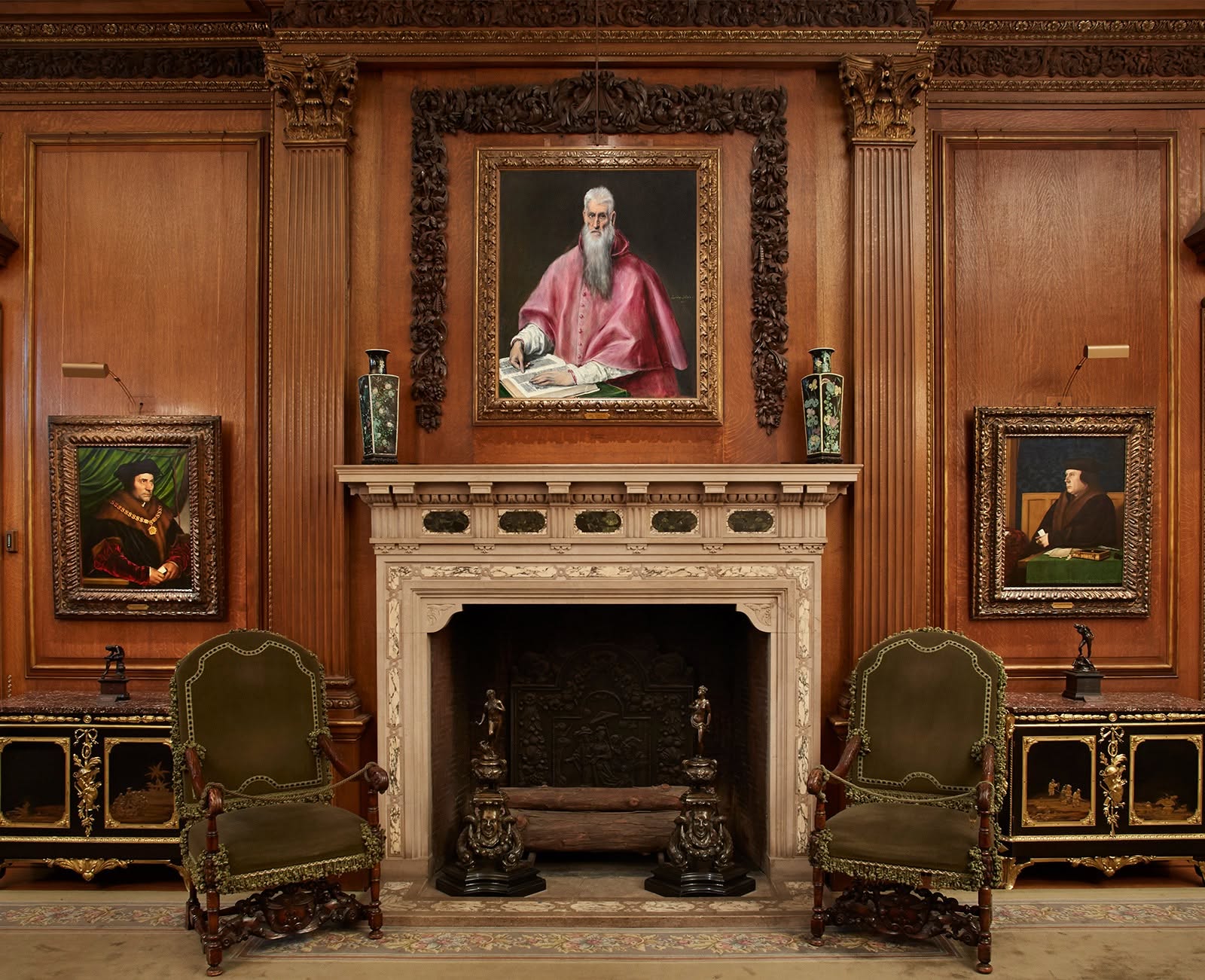
There is a portrait of Thomas Cromwell in the Frick Collection in New York. This version of Cromwell is doomed to spend all hours of the day gazing across an ornate fireplace at Thomas More. I’ve seen this duo countless times, and it never fails to delight.
Holbein’s portrait of Cromwell makes an appearance in Hilary Mantel’s Wolf Hall. According to the fictional Cromwell, Holbein made him look like “a murderer.” I am not sure if the man in the painting looks like a murderer, but I do think that he looks like a man of steel will. In Holbein’s portrait, Cromwell is surrounded by the trappings of power and wealth — sumptuous textiles, a rich fur collar, glints of gold on his finger and in the clasps and tooling of his book.

Although the book is prominently featured in the painting — it is the object closest to us, positioned so that one sharp corner projects outward, almost breaking through the picture plane — I confess I’ve never paid much attention to it.
As it turns out, other people have found Cromwell’s book deeply interesting. The book in the painting is thought to be based on an actual book, now held by the library at Trinity College in Cambridge:
“Research by Assistant Curators at Hever Castle, Dr Owen Emmerson and Ms Kate McCaffrey, suggests that the Book of Hours, printed in Paris by Germain Hardouyn in 1527 or 28, would have been among the books left by Cromwell to his secretary and protegé Ralph Sadleir.
And it came to Trinity from Dame Anne Sadleir who married the grandson of Cromwell’s secretary.”
Unlike earlier Books of Hours of the same caliber, which would have been written by hand by scribes, and then illuminated with hand-painted miniatures, Cromwell’s Book of Hours, luxuriously bound in velvet, with gem-set clasps and silver gilt ornament, was printed. Even the miniatures in the book started life as prints.


Thomas Cromwell’s Book of Hours is an example of the types of hybrid objects that accompany emergent technologies. It belongs neither to the Print age to come, where replicability and seriality were the point, nor to the manuscript age before it. As such, it also refuses to fit neatly or cleanly into frameworks of valuation. It is always “both/and,” as well as “neither” — a book printed on vellum, with metalcut illustrations that were meticulously hand-colored, one by one. Some examples of other Books of Hours produced by the Hardouyn workshop feature extensive decorative borders, as well as architectural ornamentation, all painted, freehand, by artists specializing in manuscript illumination. Some versions of the Hardouyn Hours, like the one held by St. John’s College in Oxford, even feature decorative red guidelines.
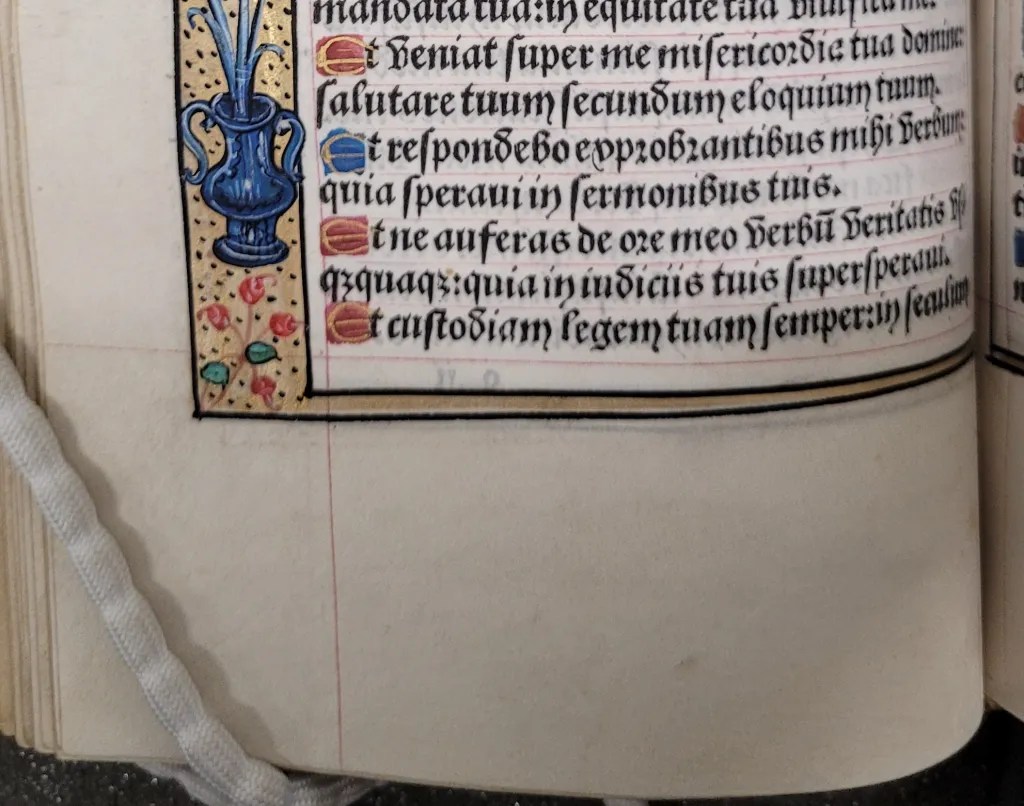
These lines, essential to hand-copied manuscripts, were unnecessary for print. Their presence in St John College’s Hardouyn Hours served to amplify the similarity between this printed Book and its manuscript brethren.
2
Since Hardouyn printed these books of hours, they have the property, if not of mass-produced replicability, at least of seriality. There are many Hardouyn Hours out there in the world, with many variations on the text, and many different approaches to the treatment of illustrations. Cromwell’s Book of Hours employed the text “for use of Salisbury,” but other Books of Hours printed by the Hardouyn workshop followed the liturgical cycles for “use of Rome,” or “use of Paris.” Judging by the diversity of surviving Books of Hours from the Hardouyn workshop, the brothers were capable of catering to a wide range of client desires.
Not all clients wanted their printed Book of Hours to resemble an ersatz manuscript. There are surviving Hardouyn Hours that feature simple hand-colored illustrations, without any decorative flourishes, and others that have no embellishment at all. And the Hardouyns weren’t the only ones producing these hybrid objects–there were other printers with similar offerings, further testament to the popularity of these objects. One wonders what drove these choices—cost considerations, aesthetics, an appreciation of the then-avant technology of print?

