I am always curious about other writers’ systems and processes, how they handle research, information management, drafting, revisions — in other words, how they handle the scaffolding, and in many ways, the actual substance, or material, of writing.
Back in graduate school, my advisor gave me a piece of advice regarding working practices: “Always keep good notes.” When I’ve stuck to his advice, I’ve profited. Whenever I’ve deviated from this advice, due to disorganization, deadlines, or sheer laziness–I’ve always found cause for regret. Over time, I’ve learned that it’s not enough to just take notes. One must also have systems of organization for them, or else those notes disappear into a black hole.
A few years ago, the Oxonian Review did a series, “On Notes,” in which various academics discussed their own note-taking processes. I knew some of the interviewees personally, and others through their work. It was interesting to see how each person’s notes (and processes) dovetailed with their personality and work.
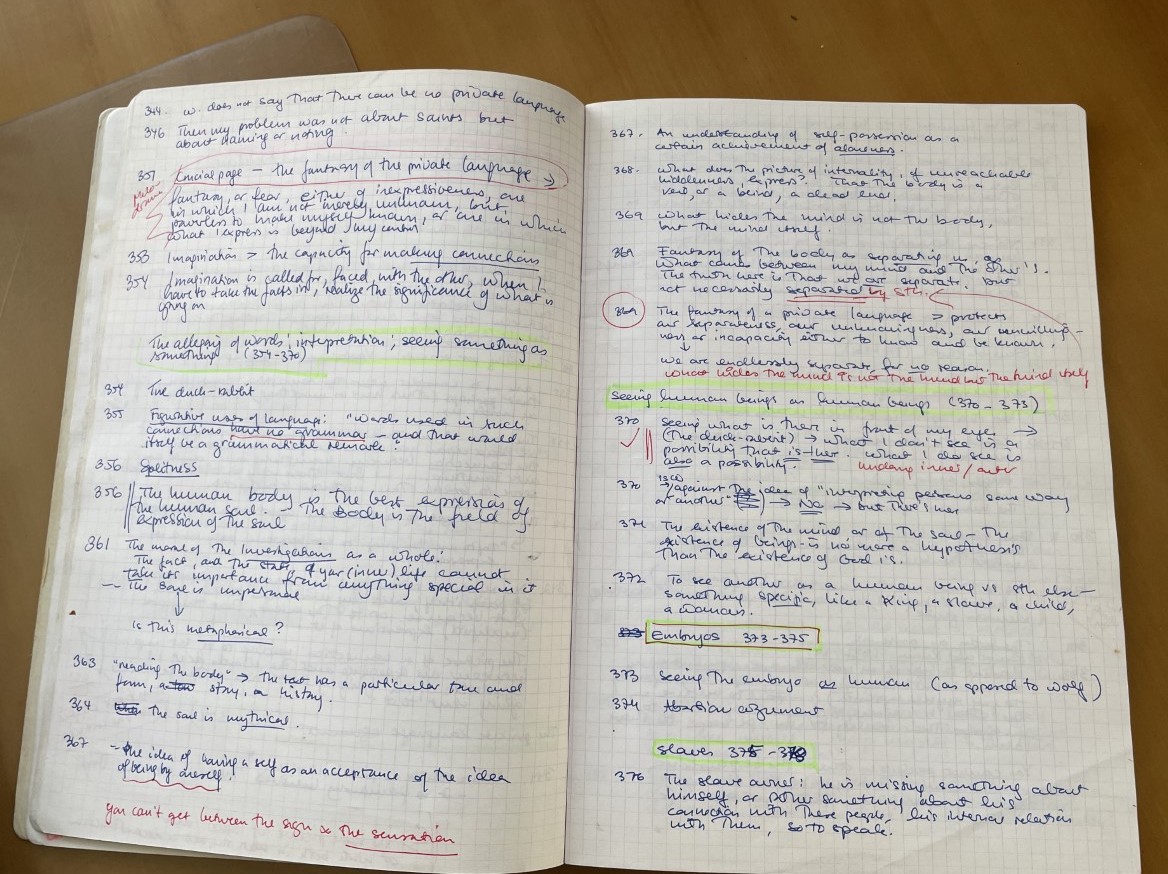
One of my favorite installments of “On Notes” featured Toril Moi. If the goal is to create a new piece of writing, some types of notes are more effective than others. “When I was a student, I took lots of notes by hand. I would copy out quotations I liked, add the page references and leave it at that,” Moi observed. “Such notes did help me to learn things, but they never contained any of my own ideas. If I looked at them a year later, they were mostly useless, for all I had were scattered quotations with no way of knowing why I had cared enough to write down precisely those lines. In any case, it was impossible to find anything in them anyway. No wonder I lost or threw away so many notebooks over the years.” What kind of notes help generate new writing? “If notes are to be building blocks for writing, I can’t focus on quotations. Nor will lists in bullet points do. The first rule is to use my own full sentences. Writing full, freshly formulated sentences, I have to connect my scattered thoughts. In short: I have to think.”
Martin Jay was one of my favorite college professors. I was not surprised to learn that, like Burckhardt, Jay once wrote his notes on “5” by 8″ cards.” Like Moi, Jay combines handwritten notes with digital ones, but each writer has their own idiosyncratic system. Moi’s notes live in a searchable database on her computer. Her notes might start their lives as handwritten passages on paper, but they end up digitized, “in a database that allows for links and backlinks.” Jay’s working notes are fully digital, but it seems like his writing notes are not:
When it comes to ideas rather than sources or previous analyses, I often will begin actually writing an essay or chapter before my own are fully cooked—I find I can formulate my argument only through the process of articulating it, not before—and then add little notes to myself about possible themes to address or points to make as I go along. These I stick at the bottom of the draft text, and when I incorporate them (or decide not to), they are deleted. So in a way the process is like climbing Wittgenstein’s famous ladder, which is thrown away after it’s been used.
Jay also offers a useful piece of advice for handling citations during the writing process: “I also find it cuts down the time to produce a final manuscript if you finish footnotes as completely as possible when you introduce them, rather than return to the text and chase down information at a later date.” I can attest that this is the best way. Every time I’ve gotten clever, or lazy, and used placeholders instead of simply finishing the footnote, I’ve deeply regretted it. And yes, it does take at least twice as long if you have to retrace your own steps.
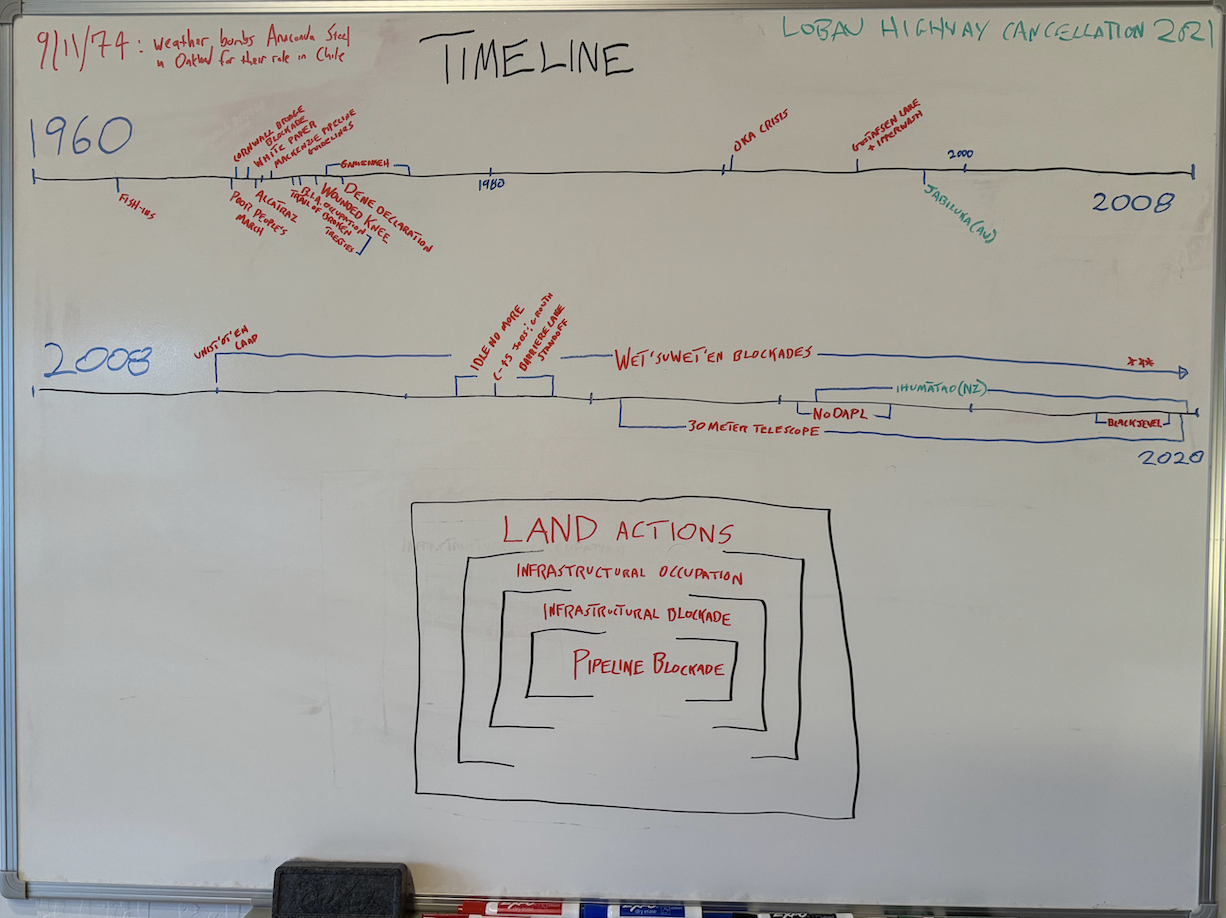
If Jay and Moi are primarily text-centered thinkers, others are more visual. Joshua Clover shared his whiteboard:
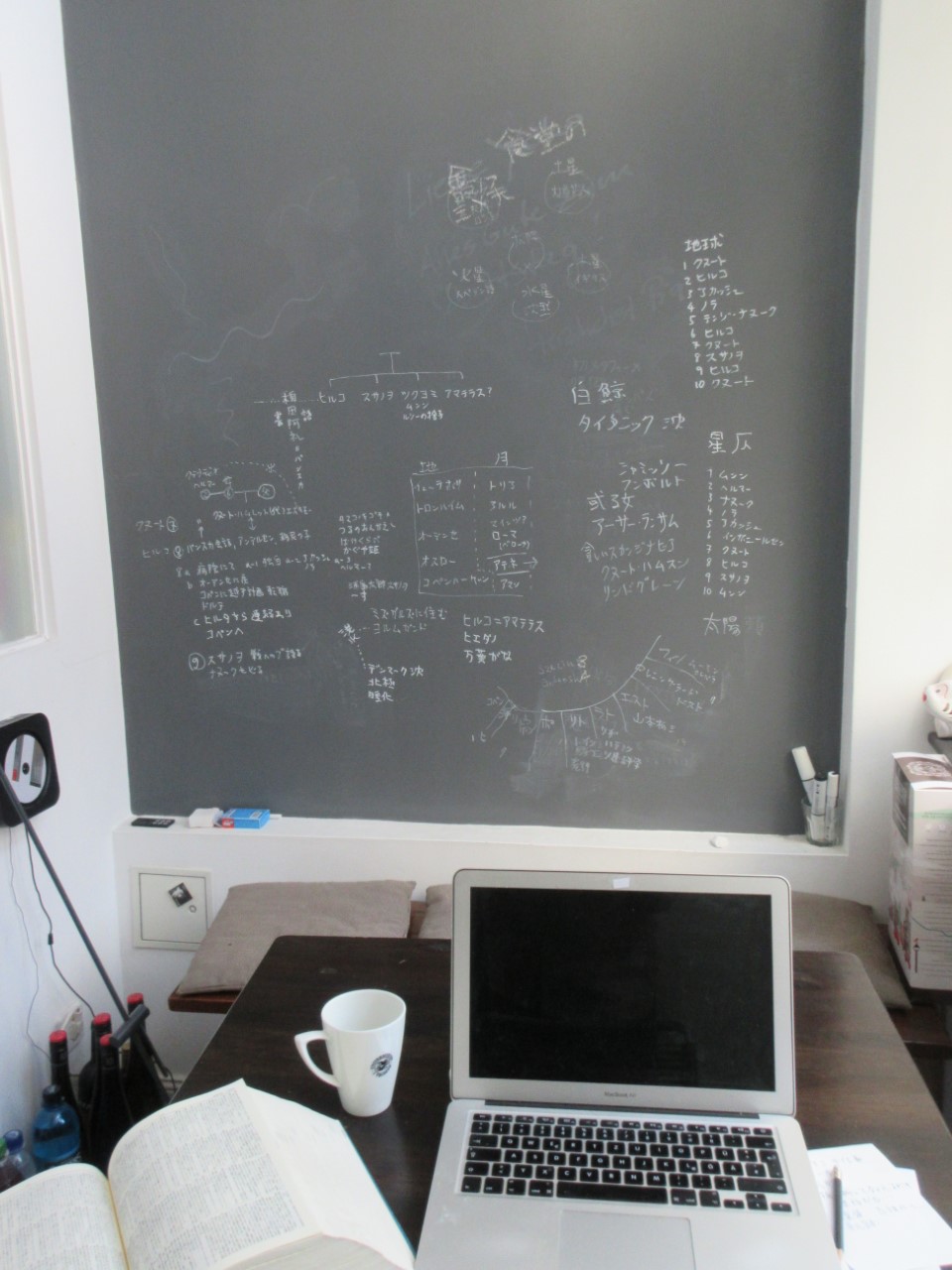
The novelist Yoko Tawada uses a blackboard to keep track of characters, places, names, abbreviations, and other concepts associated with her current project.